“Ur-Fascism is based upon a selective populism, a qualitative populism, one might say. In a democracy, the citizens have individual rights, but the citizens in their entirety have a political impact only from a quantitative point of view—one follows the decisions of the majority. For Ur-Fascism, however, individuals as individuals have no rights, and the People is conceived as a quality, a monolithic entity expressing the Common Will. Since no large quantity of human beings can have a common will, the Leader pretends to be their interpreter. Having lost their power of delegation, citizens do not act; they are only called on to play the role of the People. Thus the People is only a theatrical fiction.
Umberto Eco, “Ur-Fascism”
Note: I don’t know how good this is, but I am very angry at Platner and his defenders, so here it is. Please forgive my potentially sloppy writing.
CN: Mentions of sexual violence
Capital inhales flesh and exhales image, necrotizing the earth with simulacric waste. To defend itself, it conjures tulpas, Demiurgic animations of the self-image of the oppressed, selling the proletariat back to itself as an empty skinsuit puppeted by the psychosocial circulation of attention, quality brutalized into value. Politicians, celebrities, bureaucrats, artists, philosophers, community leaders, and heads of industry are all subsumed into their ideological image, living semiotic sculptures stripped of breath and depth. Speeches no longer have contained audiences but are refracted through a Gothic web of symbolic architectures, growing and decaying in the soil of a million atomized and imaginary communities. The ‘I’ of the public figure ceases to be the I of a human being but instead an artifact placed in the town square for all to claim as their own, recycling the I of the tulpa into the I of those the tulpa mirrors.
Graham Platner is one such tulpa, a mercenary, military contractor, para-fascist, and rapist presented as the spearpoint of proletarian struggle. “His” Totenkopf is waved away as ignorance, because apparently a grown man in military contracting is unaware of the meaning of the well-known image he has carved into his chest, not just any skull and bones but the SS Totenkopf of 1934-1945. Surely he’s on our side, though, right? When have fascists ever tried to consume the left by garbing itself in our myths? Faced with the rise of Trumpian autocracy, the hollow deathshead of capitalist decay and bunker nationalism, the electoral left learns the wrong conclusion: that the issue was that Harris seemed out-of-touch, weak, even feminine, and that what we need is a salt-of-the-earth swashbuckling type, a golem conjured from the collective imagination of what the Maine white working-class must look like. No need to vet so long as he parrots the right slogans and casts himself as an anti-imperialist (pay no attention to what he did overseas), what matters is that he looks the part.
Faced with a supposed right-populism, Platner’s inner circle devised a left-populism — after all, it is the People capital-P that we represent, right? Class consciousness is boiled down into a fine syrup and passed through a sieve, oppressed classes collapsed together into a simulacric image of the masses, an alien creature that floats above history, pretending that commitment to the Third Estate is enough (no need to look at the way the Third Estate generates its own power by the same machinery as the First and Second, climbing atop the corpses of the designated-dead, those colonized by Empire). In the vacuum of proletarian expression, where the bare stability of life begins to crumble with no apparent way out and no way to scream for help, left-populism offers a tulpa: an enfleshed stand-in for the semiotic image of proletarian identity. However, this “proletarian identity” does not emerge from the oppressed themselves, who generate their own multiplicity within their communities, but as a prescription from a professional vanguard. Platner’s campaign takes this synthetic identity and fuses it with the man himself, allowing his own complicity in subjugation and violence to become obscured or even flipped into demonic appeal. Even now, the buzzing electron clouds of online avatars reply: yes, maybe he’s a rapist, but he’s our rapist, don’t you see? If Trump can do it so can he.
Platner is not, however, a flawed or even villainous prole, nor is his behavior equal to harmful actions taken by members of the working class. It would be idiotic to pretend that fascism and sexual violence are not pervasive in many proletarian communities, but it would likewise be idiotic to think that Platner is one such example. His sexual violence, his participation in imperialist extraction, and his “accidental” Nazi tattoo are not incidental, but a reflection of who he is and what he represents: a devouring of the movement for proletarian self-abolition by the mobilization of racialized and gendered class identity. This is the sense in which he is para-fascist (if not outright fascist, given, again, the fucking Nazi tattoo). Though fascism serves the interests of the ruling class through Caesaric reaction, it does so by coopting the libidinal resentment of the middle class and labor aristocracy. As Empire reaches the limits of extraction, the members of the Third Estate who experienced relative stability through that extraction become resentful of those above them and fearful of those below, seeking an expression of their anger. On the right, this takes the image of explicitly racialized and gendered politics, where the racial other, the lumpenproletariat, the migrant, and the gender-deviant become scapegoats for the hollowing-out of industrial and agricultural communities. However, on the left, these politics are not absent but are sublimated into less-conspicuous representations, where the “working class” becomes a stand-in for those same racialized and gendered anxieties. Sexual violence and racism become acceptable not as aberrations but as ruptures of the real into the image.
The strategy here, whether conscious or not, is that the oppressed must be represented, rather than govern themselves. In one sense, the representation is literal: the vanguard, whether democratic or dictatorial, becomes separated-off as saintly keepers of the revolution, showing the “masses” what they really want, whether they think they want it or not. In another sense, the representation is a form of abstraction: the oppressed cannot inhabit their own flesh, order their own communities, or form their own cultural apparatus, but must instead be given an image of what it is that they are. Graham Platner is a representation in both senses: a member of the vanguard who rules the working class supposedly for its own sake as some Lukácsian martyr, and an abstracted image of what the working class should take itself to be, an image that is always-already in service to the ruling class through its reduction of the plurality of oppressed communities into a symbol of its most privileged members, activating the same racialized and gendered resentments that fuel fascism.
Getting rid of Platner is a good start, he should have been thrown into the wastebasket from the beginning. However, the problem that he represents is much deeper and is one that will haunt the self-declared organs of proletarian revolution so long as they participate in the politics of representation. So long as we reify the false image of a united working-class, and so long as we pretend that proletarian rule is vertical and arboreal rather than horizontal and rhizomatic, we will continue to play into the fascist network of symbols and create an opening for abusers, racists, misogynists, and imperialists to coopt the movement. The goal is not class rule, but the abolition of class society. There is no proletariat without capitalism and it is capitalism that generates the mythical self-image of the working class. The first step, then, is not to take on one’s class identity as an aesthetic, but to refuse class entirely, to work in concert with others, a Unique among Uniques within a community-of-communities whose historical motion is self-abolition: the end of capitalism through the end of the proletariat, the defeat of the bourgeoisie through the refusal of class, and the creation of a new world through leaving behind the old.
Insofar as millions of families live under conditions of existence that separate their mode of life, their interests, and their culture from those of the other classes, and put them in hostile opposition to the latter, they form a class. Insofar as there is merely a local interconnection among these small-holding peasants, and the identity of their interests forms no community, no national bond, and no political organization among them, they do not constitute a class. They are therefore incapable of asserting their class interest in their own name, whether through a parliament or a convention. They cannot represent themselves, they must be represented. Their representative must at the same time appear as their master, as an authority over them, an unlimited governmental power which protects them from the other classes and sends them rain and sunshine from above. The political influence of the small-holding peasants, therefore, finds its final expression in the executive power which subordinates society to itself.
Karl Marx, The Eighteenth Brumaire of Louis Bonaparte
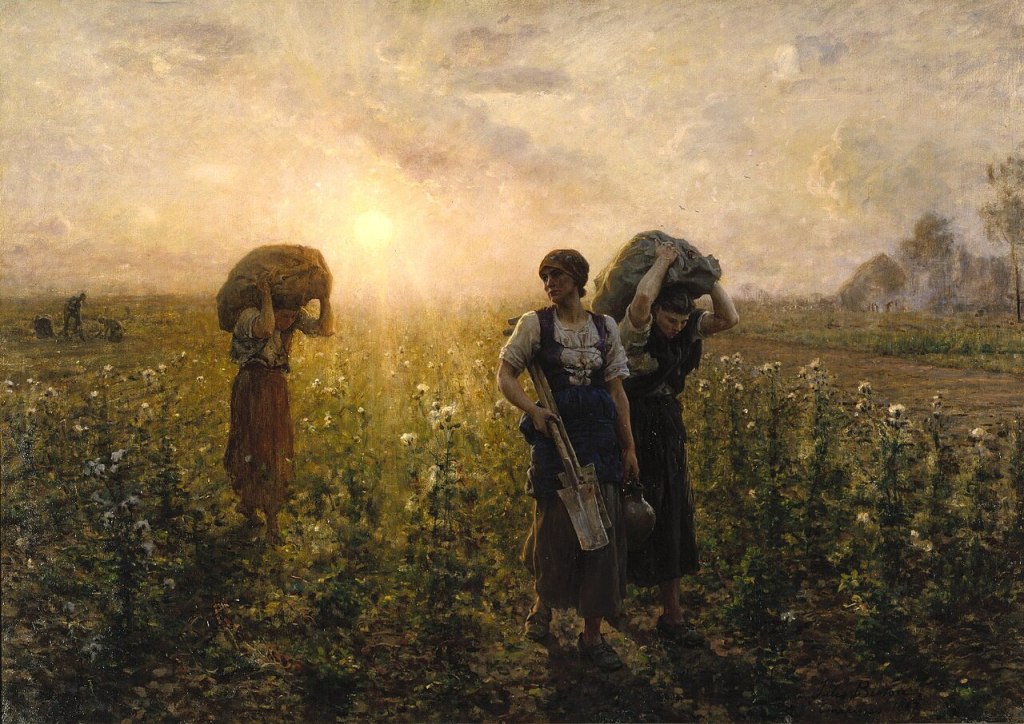
Image: The End of the Working Day by Jules Breton (1886-87)

 Fish In the Afternoon