A curious thing about the ontological problem is its simplicity. It can be put in three Anglo-Saxon monosyllables: ‘What is there?’ It can be answered, moreover, in a word— ‘Everything’—and everyone will accept this answer as true.
W.V.O. Quine, “On What There Is”
Perdure. A part of me is here; a part of me will always be there, tangled in the fantasy between once-was and never-will-be. Echopathy. Difference-in-repetition wanders enfleshed rhythms that feel and sense, trauma cohering in the body by (bye) by the skin of time (good morning and good night and good bye). Terror clings to our (to my) to our presence-to-oneself, the fearful (crying) fearful please come home. I don’t know where to begin.
Memory beckons from the future, dancing in the spotlight of the soul. It follows: I am, I was, I will be. Phoenix grays halo my brow, the dust settling marble on my aging temples. I tremble to appear. Senses carry past-presence-participle one’s being-here. The first question I must ask: where am I in my body? Kneel in the grass and dream tender, little changeling. We wake and sleep in the shadow of recurrence, everything must begin (everything must end) everything must.
I — the melancholy of choosing oneself. Endure. Because I must. The essence that names fail to name is the apophatic all, the rushing flow-flow-flow of this-here-now that streams through the garden of everywheres. We grow and decay in the shade of many looping cycles, seasons and modes of life and her-and-his-and-their-stories. Here, the sive between Deus and Natura, we are watered by the divine office and baptized in communion with the whole. Cradle her (them) her, mother of matter, in the wake of Yggdrasil’s unfolding. Perdure.
The first element, which constitutes the actual being of the human mind, is the idea of some particular thing actually existing.
Baruch Spinoza, Ethics: Pt. II, prop. 11
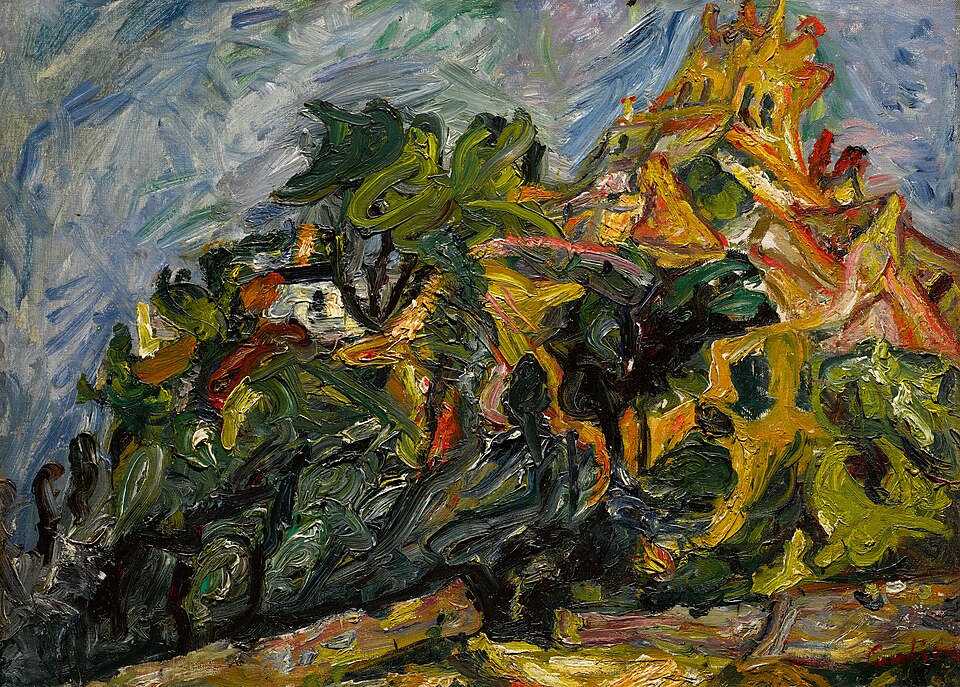
Image: Vue de Céret by Chaïm Soutine (1922)


