Skip to content
    • About
    • Recommended Reading
    • Where to Start

Fish In the Afternoon

  • Interlude: PhilPapers 2020 Survey

    September 16th, 2024

    This is for fun and not to be taken as a final statement of my positions. Here is the original.

    Questions

    • A priori knowledge – no or yes – no – The a priori is a patterning of the a posteriori.
    • Abortion (first trimester, no special circumstances): permissible or impermissible? – permissible – Every body is someone’s body and that body is theirs to do with as they will.
    • Abstract objects – platonism or nominalism – nominalism – Everything is Unique.
    • Aesthetic experience: sui generis, pleasure, or perception? – Sui generis – Aesthetic experience is a synthesis of appearance into a sui generis experience.
    • Aesthetic value – subjective or objective – both – The aesthetic experience is subject-objective, being a synthesized relationship between the Unique and the world.
    • Aim of philosophy – wisdom, understanding, truth/knowledge, happiness, or goodness/justice – wisdom – Loving-Wisdom.
    • Analysis of knowledge: other analysis, justified true belief, or no analysis? – no analysis – Knowing is a collection of patterned motions and cannot be analyzed in itself.
    • Analytic-synthetic distinction – yes or no – no – The analytic is a patterning of the synthetic.
    • Arguments for theism (which argument is strongest?): design, cosmological, ontological, moral, or pragmatic? – ontological – All the world patterns the One; this One is God.
    • Belief or credence (which is more fundamental?): neither, credence, or belief? – credence – The Unique leans in its knowing and this leaning is always a maybe, a possibility inherent in the relationship between Unique and world.
    • Capital punishment: permissible or impermissible? – impermissible – The self-ownership of the Unique precludes its annihilation by the state.
    • Causation: nonexistent, counterfactual/difference-making, primitive, or process/production? – process/production – From nothing, the cosmos patterns itself into an echoic ocean, with each event linked to others by their position in the pattern.
    • Chinese room: doesn’t understand or understands? – understands – Knowing is a doing and it is the room as a whole that does the act of knowing.
    • Concepts: empiricism or nativism? – empiricism – The Unique in itself is a creative nothing; only through relationship with the world does the Unique come to inhabit meaning.
    • Consciousness: functionalism, eliminativism, dualism, panpsychism, or identity theory? – (hylomorphic) pan(proto)psychism – All matter is spiritmatter, blessed with the immanent potential of consciousness, realized in the relationship between subject and object.
    • Continuum hypothesis (does it have a determinate truth-value?): indeterminate or determinate? – indeterminate – Mathematics is an a priori patterning of the a posteriori in our thought and practice; because of this, it is a tool that contains its own indeterminacies and contradictions.
    • Cosmological fine-tuning (what explains it?): no fine-tuning, design, multiverse, or brute fact? – brute fact – The pre-conditions for knowing the fact and the pre-conditions of the fact being true are the same.
    • Eating animals and animal products – vegetarianism, veganism, or omnivorism – omnivorism – In right relationship, we can eat animals; in right relationship, they can eat us.
    • Environmental ethics: non-anthropocentric or anthropocentric? – non-anthropocentric – Though our perspective is rooted in the human Unique, it stretches out beyond it in a way that does not assume human primacy.
    • Epistemic justification – internalism or externalism – externalism – The world is prior to the interior. There is no private language.
    • Experience machine (would you enter?) – yes or no – no – The experience machine is just one experience out of many.
    • Extended mind: no or yes? – yes – The mind is identical with the world and the tools that extend our en-minded activity are themselves en-minded.
    • External world – skepticism, idealism, or non-skeptical realism – idealist non-skeptical realism – The world and the mind are identical. The appearances of the world are facets of the world as the summation of en-worlded experiences.
    • Footbridge (pushing man off bridge will save five on track below, what ought one do?) – don’t push or push – indeterminate – One wisely does in the moment.
    • Foundations of mathematics: set-theoretic, formalism, constructivism/intuitionism, logicism, or structuralism? – constructivism/intuitionism – Mathematics is an a priori patterning of a posteriori thought and activity and thereby the structure of mathematics reflects the structure of that activity.
    • Free will – compatibilism, no free will, or libertarianism? – compatibilism – Free will patterns the will that patterns it.
    • Gender – unreal, biological, social, or psychological? – all of the above – When I woman, is the anima that does it biological, social, or psychological?
    • Gender categories: revise, preserve, or eliminate? – revise – Let a million genders bloom.
    • God – atheism or theism? – (pan)theism – The divine inhabits the world as perichoretic kenosis, the indwelling, self-giving love of creating-begetting-proceeding.
    • Grounds of intentionality: phenomenal, primitive, inferential, interpretational, or causal/teleological? – phenomenal – Intention is an orientation of en-minded activity that is experienced self-reflectivity in that activity.
    • Hard problem of consciousness (is there one?): yes or no? – no – Matter and en-minded activity are the same.
    • Human genetic engineering: impermissible or permissible? – permissible – The possibilities of implementation are too varied to decide the permissibility of them as a class.
    • Hume (what is his view?): skeptic or naturalist? – naturalist – Hume demonstrates the limits of philosophy to ground a Newtonian stance towards the natural sciences.
    • Immortality (would you choose it?): yes or no? – no – The horizon of death manifests the arena of our mattering.
    • Interlevel metaphysics (which is the most useful?): grounding, supervenience, identity, or realization? – realization – Ways-of-talking about the world are bound together in our experience by the mutual realization of those ways-of-talking in the world.
    • Justification: infinitism, reliabilism, nonreliabilist foundationalism, or coherentism? – reliabilism – Knowing is a doing. We only know to the degree that we do in knowing.
    • Kant (what is his view?): one world or two worlds? – one world – Kant synthesizes his quasi-idealism for the sake of reconciling the Humean picture to philosophical knowledge, showing how the limits of experience relate to the world in which that experience occurs.
    • Knowledge – empiricism or rationalism? – empiricism – The interior is a patterning of the world; thought synthesizes experience into reason.
    • Knowledge claims: relativism, contextualism, or invariantism? – contextualism – There is no knowledge, there is only knowing, in a place, in a time, in a world.
    • Law: legal non-positivism or legal positivism? – legal positivism – The law is a patterning of human activity that has a law-like authority in a given social system.
    • Laws of nature – non-Humean or Humean? – Humean – The cosmos patterns the laws like deep canyons in a mountain range.
    • Logic: classical or non-classical? – both – Logic is a doing; types of logic do different things.
    • Material composition: restrictivism, nihilism, or universalism? – universalism – Everything is the same thing patterning itself infinitely as the many-in-one.
    • Meaning of life – objective, nonexistent, or subjective? – both subjective and objective – Life means.
    • Mental content – internalism or externalism? – externalism – The world is prior to the interior; the interior is part of the world.
    • Meta-ethics – moral anti-realism or moral realism? – moral anti-realism – You cannot touch the good, but only that which the good belongs to.
    • Metaontology – anti-realism, deflationary realism, or heavyweight realism? – heavyweight realism – Though at base all there is is the flow of en-minded matter-in-activity, this matter composes all that there is, which exists just as much as the matter that composes it.
    • Metaphilosophy: non-naturalism or naturalism? – non-naturalism – Philosophy is a patterning of thought that interrelates with, but is distinct from, the natural sciences.
    • Method in history of philosophy (which do you prefer?): contextual/historicist or analytic/rational reconstruction? – contextual/historicist – Philosophers write from a place and a time and a body, and only with these locations in mind can we unravel their thought.
    • Method in political philosophy (which do you prefer?): ideal theory or non-ideal theory? – non-ideal theory – To change the world we must first start from attention to the good of the particulars around us.
    • Mind: physicalism or non-physicalism? – physicalism – All matter is en-minded, though matter it remains.
    • Mind uploading (brain replaced by digital emulation): survival or death? – death – The dis-assembly of the anima that enfleshes a particular subjectivity ruptures that subjectivity. Even if it is re-assembled, the subjectivity will contain that rupture.
    • Moral judgment: cognitivism or non-cognitivism? – non-cognitivism –Moral judgment is a type of mattering, an intertwining of subject-object that normatively and affectively colors the world
    • Moral motivation: externalism or internalism? – externalism – We are always driven both by what is within us and by the world; there is no desire that is not an intertwining of self-and-other.
    • Moral principles: moral particularism or moral generalism? – moral particularism – All moral commitment is to a Unique or a Unique together.
    • Morality: non-naturalism, constructivism, expressivism, naturalist realism, or error theory? – expressivism – The mattering of moral judgment is affectively-laden, creating an emotional landscape that one navigates in doing-good in the world.
    • Newcomb’s problem: one box or two boxes? – two boxes – Rob that robot.
    • Normative concepts (which is most fundamental?): ought, reasons, value, or fit? – value – Mattering more specifically, but mattering is closest to value.
    • Normative ethics: consequentialism, virtue ethics, or deontology? – virtue ethics – Morality is learning to navigate, disclose, and co-constitute the world as intertwined with the matterings of others and oriented towards the good of those we are committed to. This is accomplished through practice and the training of our intentions and attention.
    • Other minds (for which groups are some members conscious?) – all – All matter is en-minded.
    • Ought implies can: no or yes? – no – Our commitments many times brush up against the impossible, a tragic limit of our virtue that also creates the horizon of our mattering.
    • Perceptual experience: sense-datum theory, representationalism, qualia theory, or disjunctivism? – representationalism – We perceive the space-between as a representation of the intertwining of our faculties and the powers of things-in-the-world.
    • Personal identity: biological view, psychological view, or further-fact view? – psychological (narrative) view – Our identity is one that we narrate and which is narrated by others.
    • Philosophical knowledge (is there any?): none, a little, or a lot? – a little – I know that Schopenhauer was a fucking dork.
    • Philosophical methods (which methods are the most useful/important?) – all – Philosophy is an orientation, not a method.
    • Philosophical progress (is there any?): a lot, a little, or none? – a little – I am better than Schopenhauer.
    • Plato (what is his view?): knowledge only of forms or knowledge also of concrete things? – knowledge also of concrete things – Even if things-in-the-world are shadows of the forms, one knows the shadows in knowing the forms.
    • Political philosophy: communitarianism, egalitarianism, or libertarianism? – egalitarian communitarianism – Political community is an extension of friendship and neighborly-care and requires both the attention to the community as a community and an equality between those within the community.
    • Politics: capitalism or socialism? – socialism – Capitalism is a death cult.
    • Possible worlds: concrete, abstract, or nonexistent? – concrete – At the highest level of representation, the real is a landscape of possibility, within which lies the gradient of worlds.
    • Practical reason: Kantian, Humean, or Aristotelian? – Humean & Aristotelian – Practical reason is a pairing of attention and intention that overlaps both with the desire-focus of Hume and the more complex habitual reason of Aristotle.
    • Principle of sufficient reason: false or true? – false – The cosmos allows for uncaused possibilities.
    • Proper names: Millian or Fregean? – Fregean – No naming is devoid of sense.
    • Properties: transcendent universals, immanent universals, nonexistent, tropes, or classes? – tropes – Properties are patterns that we bundle in our activity.
    • Propositional attitudes: representational, phenomenal, nonexistent, or dispositional? – dispositional – A propositional attitude is a type of intention, disposing us to particular forms of activity.
    • Propositions: structured entities, nonexistent, acts, sets, or simple entities? – acts – Propositions are doings which flow into and out of our propositional attitudes.
    • Quantum mechanics: hidden-variables, epistemic, many-worlds, or collapse? – many-worlds – Fuck if I know, but that sounds right.
    • Race: unreal, social, or biological? – all of the above – Race is not a static thing, but a doing and a process: racializing. This activity is simultaneously imaginary, constituted from social and historical processes, and bound to biological characteristics that are not racialized prior to these social processes.
    • Race categories: revise, eliminate, or preserve? – revise – In the long-run, eliminating race categories might be the goal. However, so long as racialization is a major form of oppression, the goal is instead to revise our racial categories so as to undermine that oppression and allow for solidarity among oppressed groups.
    • Rational disagreement (can two people with the same evidence rationally disagree?): non-permissivism or permissivism? – permissivism – Reasons appear differently in the knowing of different people.
    • Response to external-world skepticism (which is strongest?): semantic externalist, pragmatic, contextualist, dogmatist, abductive, or epistemic externalist? – abductive – The external world is a required assumption for our abductive practices of knowing, and these abductive practices are generally reliable and central to our epistemic schemas.
    • Science: scientific realism or scientific anti-realism? – scientific anti-realism – Scientific knowing does not represent the world as it is, but the world as it operates in our doings.
    • Semantic content (which expressions are context-dependent?): minimalism (no more than a few), radical contextualism (most or all) , or moderate contextualism (intermediate)? – radical contextualism – No utterance exists outside of its location.
    • Sleeping beauty (woken once if heads, woken twice if tails, credence in heads on waking?): one-half or one-third? – one-half – Sure, that seems right.
    • Spacetime: substantivalism or relationism? – relationism – Spacetime is an entanglement of en-minded matter.
    • Statue and lump: one thing or two things? – two things – Things are constituted by their intertwining with subjects, and this intertwining allows for multiple patterns of conceptualization to layer on top of the same spacetime bundle.
    • Teletransporter (new matter): death or survival? – death – I have a suspicion that if I get zapped and vaporized that I die.
    • Temporal ontology: presentism, growing block, or eternalism? – growing block – In some sense time is eternal, in that the highest representation of the universe is a landscape of possibilities. However, time as it is experienced grows from our intertwining and echoing.
    • Theory of reference: causal, deflationary, or descriptive? – deflationary – There are multiple, rather than solely one, practices of reference.
    • Time: B-theory or A-theory? – A-theory of a sort – Time as it is experienced is form from our intertwining and echoing, and these doings are sequenced, creating the perception of ordered time even as time at the highest representation is eternal.
    • Time travel: metaphysically impossible or metaphysically possible? – metaphysically possible – Extremely unlikely, but theoretically possible. I do not know how you do it but I don’t have a good reason that you could not, in principle, navigate time.
    • Trolley problem (five straight ahead, one on side track, turn requires switching, what ought one do?): don’t switch or switch? – indeterminate – The right decision is made in the moment through attention to the particularities of the situation.
    • True contradictions: possible but non-actual, impossible, or actual? – actual – Our matterings may be contradictory, creating normative and affective landscapes that are internally in tension with themselves.
    • Truth: epistemic, correspondence, or deflationary? – epistemic – Truth refers to a wide spectrum of doings and ways that those doings matter to us.
    • Units of selection: genes or organisms? – organisms – A gene is nothing without its conjoined expression in the organism.
    • Vagueness: epistemic, semantic, or metaphysical? – all of the above – Our sayings are vague, our knowings are vague, and the universe itself has blurred and many times indeterminate lines.
    • Values in science (is ideal scientific reasoning necessarily sensitive or insensitive to non-epistemic values?): necessarily value-laden, can be either, or necessarily value-free? – necessarily value-laden – Science is itself a mattering (or a set of matterings), such that it cannot be effectively done without being value-laden.
    • Well-being: hedonism/experientialism, desire satisfaction, or objective list? – experientialism – Well-being is a mattering that is unveiled in our lived experience.
    • Wittgenstein (which do you prefer?): early or late? – both – There is no contradiction.
    • Zombies: inconceivable, conceivable but not metaphysically possible, or metaphysically possible? – inconceivable – Our perception of doings already contains the assumption of consciousness; there is no way to have the doings of an organism and not the experience that occurs with those doings.
  • The Myth of America

    September 11th, 2024

    At a signal from the Principal the pupils, in ordered ranks, hands to the side, face the Flag. Another signal is given; every pupil gives the flag the military salute — right hand lifted, palm downward, to a line with the forehead and close to it. Standing thus, all repeat together, slowly, ‘I pledge allegiance to my Flag and the Republic for which it stands; one Nation indivisible, with Liberty and Justice for all.’ At the words, ‘to my Flag,’ the right hand is extended gracefully, palm upward, toward the Flag, and remains in this gesture till the end of the affirmation; whereupon all hands immediately drop to the side. – Francis Bellamy, The Youth’s Companion

    1776 is not a year but a signifier. In the agon, matterings war with one another, emanating history. Long ago, Luther’s children escape the restoration, taking Cromwell’s skull to Turtle Island. Their God chooses, baptizing in water and pneuma. The first baptism is a sign of the second; the second is God’s will. Either way, the earth-soul breathes. The roundheads fence the world, reifying God in the market and separating themselves off as white. The Puritans mistake their flesh for divinity and case their hue as cosmogonic. The white world is birthed from idolatry, enfleshing the violent superego of settlers, slavers, and conquistadors. O woe to you, Vespucci.

    The proletariat is an invention. In the dusk of the Black Death, the bourgeoisie emerge, exchange eclipsing feudalism as peasants are stripped of their land and women are burned on stakes. Capitalism is a witch hunt – the witch of rebellion that haunts history, the world turned upside down. Making the yuletide gay. Puritans are theologians of the market, crushing the un-chosen carolers with the God of enclosure. The kingdom collapses and its grave births Leviathan, Hobbes’ nightmare of man against man, the myth of the terror. Together, this terror and the Puritan God re-write history, capital crawling snarling out of the pit of England. America never left Plymouth Rock.

    Capitalism starts from covenant, from the predestination of the saints. TULIP is an acronym for the Time-Machine. Lost on Mt. Ararat, the Rushdoonys whistle Yankee Doodle Dandy, burying theocracy in the heart of the slaver’s republic. In July, the plantation billionaire signs his separation, the teeth of the dead rotting in his mouth. Leviathan finds fathers for its parasitic creation: settler democracy. A demos of occupiers and property-owners, the double-image of the Athenian executors. Tyranny masks itself in the guise of the people, the general will confiscated by the homeowner’s association. Race becomes a mark for the covenant as women are privatized and the land is terraformed into territory. The mark of the pneuma is race-capital, the fetishization of value reified in flesh.

    The fasces is a Roman invention, appropriated from the ash of Minos. Caesar glimpses the chi-rho written in the sky and the Carpenter is crowned king. No longer an executed criminal, the Begotten One is re-made in the image of the enslavers and occupiers, the temple of Augustus built on the ruins of Golgotha. The axe returns again-and-again, inaugurating Charlemagne, Washington, Bonaparte, and Hitler. At its core is the imperium, the synthesis of God and Caesar, carried from Augustus to their Puritan offspring. Yockey imagined what was already being born: a white imperium, carried from Europe to the occupied lands. Romulus kills Remus and spills his blood on the steps of the Capitol. The challenge of the Carpenter remains: to render unto Caesar what is Caesar’s. To not put your faith in false gods.

    And in princes who cannot save.

    As against this, the commodity-form, and the value-relation of the products of labor, within which it appears, have absolutely no connection with the physical nature of the commodity and the material relations arising out of this. It is nothing but the definite social relation, between men, themselves, which assumes here, for them, the fantastic form of a relation between things. In order, therefore, to find an analogy, we must take flight into the misty realm of religion. There the products of the human brain appear as autonomous figures endowed with a life of their own, which enter into relations, both with each other and with the human race. So it is in the world of commodities with the products of men's hands. I call this the fetishism which attaches itself to the products of labor as soon as they are produced as commodities, and is, therefore, inseparable from the production of commodities. - Karl Marx, Capital, Vol. 1

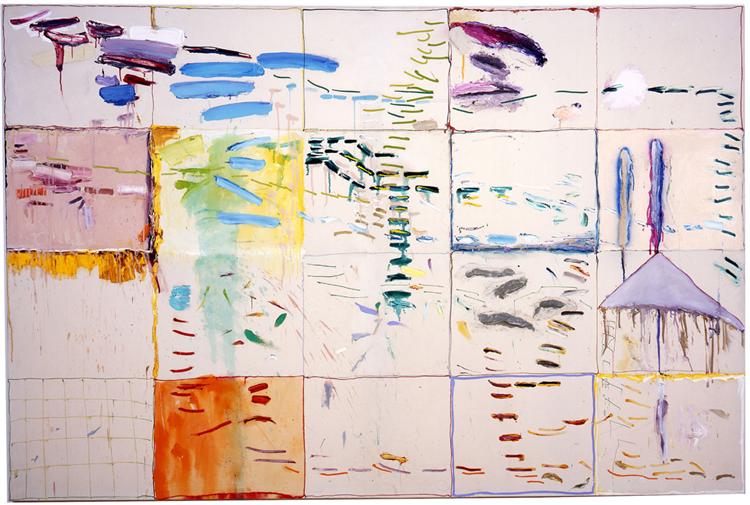
    Image: American Dream by Brett Whiteley (1969)

  • Among the Willows

    September 7th, 2024

    Naturam expellas furca, tamen usque revenit. – Horace, Epistles

    Slow. I am at rest. No. I am not resting. We beings breathe the three-in-one, creating-begetting-proceeding. The divine does; the imago deis. We are parched, desert-time frosting catabolic catastrophe, the dust unsettles in place. I am kudzu. Body. My soul hurts. Mind. I am a vine. Spirit. I am reborn. Earth.

    Tree sap syrups the forest. Evolution paints ants along the aphid-dotted floor, the rococo of the Oversoul. Walk / Stay. Heaven drips mercy into amoral nature, strife recomposing into unity, the dance of the Dao. I am a many-worlded being, stardust teeming with bacterial galaxies. Harmony is woven difference, needles threading anima into the theater of time. I am a place I am always arriving-at. Here. When? There. Now? Being swallows the sooted pine, life ticktocks the dawn. I am a willow.

    Stop and breathe. Pause. Silent. Still. Do you move or does the world? You have turned the earth into an icon and humanity into an idol. The common-being can’t be found. (You cannot locate the universe.) We seek the already-here. Take a step back and ask: when was the last time you let the world speak? (Pity the philosopher who speaks of transcendence.) The immanent is an expanse far greater than eternity. You paint the sky and pretend it’s art; butterflies burn civilization. Wait. Brain-deep in the swamp of concepts we drown our lungs in thought. Breathing is a forgetting; knowing is anamnesis.

    Hades is a place you can touch.

    Come forth into the light of things, Let Nature be your teacher. – William Wordsworth, The Tables Turned

    Image: The Forest Edge by Gustave Courbet (n.d.)

  • The Pluricosmos

    August 29th, 2024
    Thus there is nothing waste, nothing dead in the universe; no chaos, no confusions, save in appearence. We might compare this to the appearence of a pond in the distance, where we can see the confused movement and swarming of the fish, without distinguishing the fish themselves.

    Thus we are that each living body has a dominante entelechy, which in case of an animal is the soul, but the members of this living body are full of other living things, plants and animals, of which each has in turn ita dominant entelechy or soul. - Gottfried Leibniz, Monadology 69-70

    The self is both real and not-real; it is here and nowhere. The mind is a no-mind, but a no-mind that en-minds, enfleshing sensation. Touch pianos being. I heal; over-and-again. I heal.

    Holy One, we dwell in you. We dwell in us. Us. I am also an us, galaxies of micro-life unfolding their species being. I am the cosmos for others. Others are a cosmos for me. There is never only one world. Hear. Every rustle is worlds-in-motion, the universe shimmering eternities in a modal sea. We are infinities.

    I sit still. I listen. Wait. Beauty appears first; sensation sparks aisthesis. Being poems life. Take a step back and the real swallows you, the real caresses. Where do the archons go in the winter? I spellfree my past-selves, the archipelago of ashes. I unfold like an ethic. The pluricosmos composes you; you are a many-unfolding. History owls the presentfuture. In the many-unfolding the Unique appears as awareness, the appearance that appears to itself. This Unique orients, it intends, it leans, it attends, and it acts, it means. Meaning is planted in the first Uniquing.

    Loved One, I attend to you. I attend to us. Attending is always attending-with-another, painter, painted, and paint intertwined. One experiences as the subjectobject, entangled-becomings sculpting a world-together. Ontology is attending to the entangled worlds of our togethering. Time re-members in the dreamsleep of awakening. Shhh. Wait. Listen. Silence does. It is the silence that speaks. Look. The silence rests in you, the hearth of your heart, the creative nothing that unfolds the many-worlds. The many-unfolds as the one-unfolds. We.

    Everything-together.

    Deus seu Natura. – Baruch Spinoza, Ethics IV: Preface

    Image: Cosmos No. 3, Martha Boto

  • For Harriett

    August 14th, 2024

    The animal is poor in world, it somehow possesses less. But less of what? Less in respect of what is accessible to it, of whatever as an animal it can deal with, of whatever it can be affected by as an animal, of whatever it can relate to as a living being. Less as against more, namely as against the richness of all those relationships that human Dasein has at its disposal.

    Martin Heidegger, The Fundamental Concepts of Metaphysics, §46

    Adapted from a paper for a Heidegger course.

    Harriett is a duck. I met her during a depression spell, wandering aimlessly next to the Potomac. I started visiting her because she has a hurt wing, jutting out at an acute angle and preventing her from flying. Concerned, I walked an hour-and-a-half multiple times a week to check on her, to see if she’s eating, if she’s socializing, if she’s having any trouble living her best duck life now. This practice was intended as an act of loving-care, attending to her in the ways appropriate to a duck, and I interpreted her swimming to meet me as cross-species recognition, quacking “I know you” even without the locution. Through it all, Harriett persevered, a duck-on-a-mission, swimming-about and making a life for herself among the Mallards of the Potomac. The last time I saw her, she was healthier than before, defiantly waddling through the river’s pollution, building a coven of friends, and savoring every corn kernel that comes her way.

    Harriett is and acts and becomes, unfolding the form-of-life that she inhabits. To unfold is to enact one’s agency in the world repeatedly, dancing the rhythm of being that matters the world. Being buzzes with beings that are -there and -with, always-already situated within a pluricosmos of overlapping and interweaving worlds, meanings and matterings appearing in the unfolding. Drawing from Heidegger, this unfolding depends on the project or pursuit that the creature takes up, orienting themselves to the world as that which they are and marking things in the world as occasions for, or which draw us into, action. For Heidegger, this creature is Dasein, the being-there that asks-and-nervously-answers the question of being; however, I call it the Unique, that which is itself-in-itself and irreplaceable with any other, the matter that matters the world. The Unique forms a world through inhabiting a world, matterings cascading out into the ontology of the cosmos, the Unique of all reflecting the Unique of each.

    What does a duck do? Does a duck do? Are the entities in the world significant for a duck? Do they matter? Do they help in the project of ducking? How does one duckily do in the world? It certainly seems if you throw a few grains of corn into the river that it solicits the ducks to eat, that the kernels show up to the ducks as “that which a duck like me eats.” The moment the grains ripple the water, the ducks turn and wade towards it, recognizing it as a delicious feature of their duckish life. Not everything in the Potomac solicits in this way or appears in a duck life as appropriate for a duck – the corn appears as something-to-be-eaten precisely because it is something-to-be-eaten by a duck. It is living life as a duck that causes the corn to appear as it does. Does this mean that ducks have projects or life pursuits like Heidegger’s Dasein? Well, they certainly pursue the corn, and they try to continue living life in a way that is particular to a duck, ducking through their everyday life in a way that changes what things are for. The project of a duck is to live this life, to dwell in the form-of-life of ducks. Ducks do as ducks do, and, in this doing, they constitute a duckish world, a world where things appear as for and not-for ducking.

    A duck thus does as Dasein does in ducking. A duck takes up a duck-life through being-in-the-world as a duck. In this ducking, the world becomes the world-for-a-duck, affording opportunities for waddling and wading and flying and eating and doing whatever it is that ducks do when we’re not looking. Harriett’s hurt wing prevents her from flying, blocking the potential for entities to show up as to-be-flown-from, but she still glides and wades, ducking-on in a way particular to Harriett’s unique duckishness. Duck-worlds are not all the same but depend on how individual ducks take up and pursue the project of ducking in the world. Each duck must still learn to duck-in-the-world, and this opens a world that is both grounded in the pursuit of being a duck and in the particularities of being that duck, not just generic duckishness. Harriett finds herself thrown into the world a bird with a broken wing, but every day, she ducks-on. She projects herself onto the possibilities in the world and seeks to live life as a duck, acting on and with things in a way conditioned both by her duckishness and the way she is thrown into that duckishness and into the world. We ourselves human every day. The bee bees, the duck ducks, and the human humans, but being beings in all of them, constituting a world through the project of animaling as the animal-that-one-is, one’s species-being.

    A year ago I started visiting Harriett as an act of loving-care. To love another is to attend to their unfolding as that which they are. As what she is, Harriett unfolds a world as she unfolds herself in it, matter mattering matter. To care-for and care-about Harriett is therefore to care for her as the unfolding life that she is. It means attending to the world that she makes and making it possible for her to unfold her life as a duck. Harriett is Unique, and so are the creatures that she is -with, both human and non-human. Caring for each is caring for the Unique that they are, and caring for the Unique that they are means making it possible for them to unfold their life-project, to animal. Recognizing non-humans as Uniques invites us into a new ecological ethic, to prevent ontocide through attending to the world that the Unique is and creates, a pluricosmos of different beings-in-the-world that imbue the universe with mattering.

    All worlds are full of Uniques, and Harriett and I are two. I Unique in my humaning and her in her ducking, and just as her presence helped me to human-on when humaning felt untenable, so I have a responsibility to her in her ducking, to be the duck that she is. Harriett is Unique, and so am I, together in this world of beings-in-their-worlds, making the many-worlds together.

    All things are full of gods.

    Thales of Miletus, quoted in Aristotle’s De Anima 411a

    Image: Harriett by me (2023)

←Previous Page
1 … 6 7 8 9 10 … 16
Next Page→

Blog at WordPress.com.

  • Subscribe Subscribed
    • Fish In the Afternoon
    • Already have a WordPress.com account? Log in now.
    • Fish In the Afternoon
    • Subscribe Subscribed
    • Sign up
    • Log in
    • Report this content
    • View site in Reader
    • Manage subscriptions
    • Collapse this bar