I have been a stranger in a strange land.

(Exodus 2.22)
Much of life is spent here-and-there, the archipelago of somewheres twisting-turning-winding from shore to sea to shore. We travel, we move, we stay, we leave, we’re lost, we’re found. Traveling, we go from one somewhere to another, ‘there’ rather than ‘here.’ Even when we’re ‘there’ we are never ‘here’ there. We are only ‘here’ in a somewhere that is not ‘there.’ Throughout life, we move through a forest of heres and theres, one location to another, but a there only becomes a here when we find a place in it. Here is not a static location, but a mode of dwelling, a rhythm of playful interaction that co-creates a world, the orange hue of sunrise singing firelight across the wood panel den of placetime.
The gap between spacetime and placetime is an attentional one. We reside in spacetime whenever we measure our activity by position and dimension, along spectra of latitude-longitude and yesterday-today-tomorrow. I am here in spacetime, in a there that isn’t mine that I can only trace through a four-dimensional map that never contours to the world. When I move to placetime, however, my attention drifts from position and dimension to place and time, not {x, y, z, t} but the experience of being where and when I am. Placetime unfolds, slipping off the ribbon of the present to reveal the wonder of being. I can triangulate spacetime, but placetime only emerges from entanglement, from being caught-up in the ever-flowing interactions of the world I inhabit. I never dwell in spacetime, just a point on a map signifying nowhere; I only ever dwell in placetime.
Here emerges when I am en-placed and en-timed, when I can move through the world around me as inhabitant rather than tourist. Not all motion is travel. We travel by navigation, mapping out the territory between spaces of spectacle, sites for looking, for oohing and ahhing, but never seeing, listening, living. As we come to know the here around us we move by starlight, integrating our activity into the worldscape of body-land-body, the dialectical interchange of the enfleshed pluricosmos. We no longer need the map nor the territory, but allow placetime to impress itself on our soul, to intertwine itself with us and us with it. This is when we are finally here, and when home finally presents itself to us.
Home is the intimate dwelling of placetime. When we are away from home, it is not only because we have left to go somewhere else, but because we are separated from the warmth of our dwelling. We can find fun and novelty in another somewhere, in a there we travel through, but we ache to return. Even when we have not found that home, we ache, we long, we desire to return to a somewhere to call our own. We wade in the ocean of somewheres, raising anchor there and there, but we only find land when we find home, when here emerges not only as a space we exist in, but as a placetime we inhabit with others. Home is a fireplace that never goes out and whose wood is perpetually regenerating memory. Home is the somewhere where our soul finds rest.
All I want is to return home.
There is no place more delightful than one's own fireside.

(Cicero, Epistles)
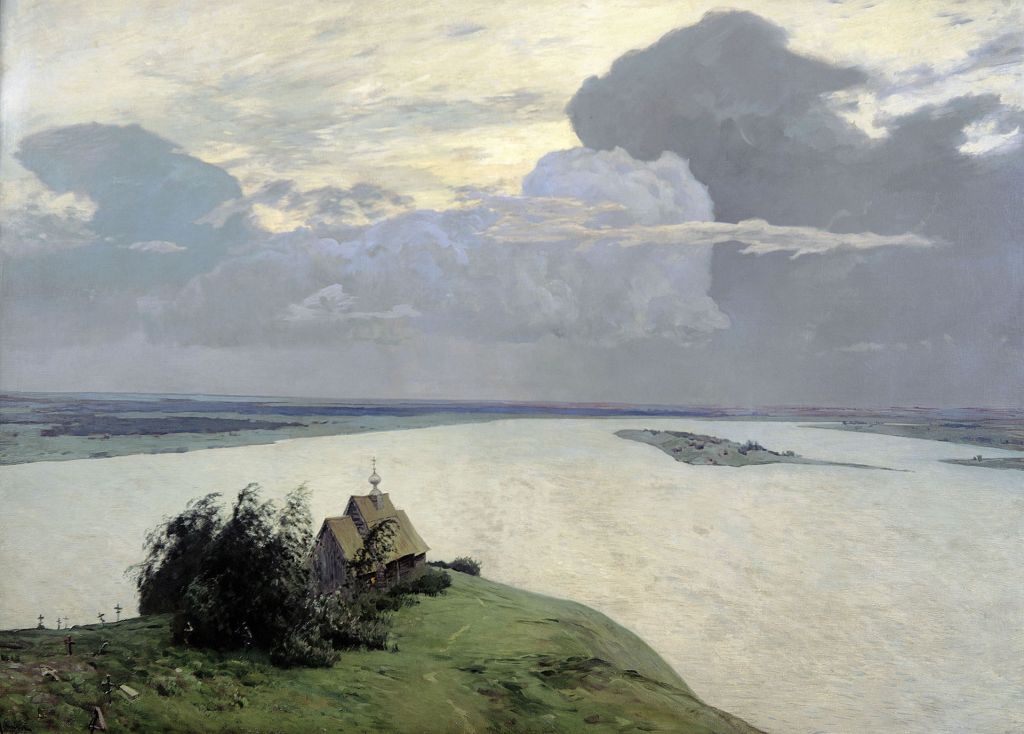
Image: Above Eternal Peace by Isaac Levitan (1894)
 Fish In the Afternoon