In order to perpetuate itself, every oppression must corrupt or distort those various sources of power within the culture of the oppressed that can provide energy for change. – Audre Lorde, Sister Outsider
I am a world, in a world, among other worlds. In my unfolding, I dwell in the placetime that grows in the commons, neither mine nor theirs. This placetime appears to me already value-laden, matterings layering on the architecture of my dwelling so that each part appears as-something and for-something. This is a chair and it is for sitting. This is a fork and it is for eating. This is a man… no, wait, a woman… no, wait… That… thing… is disjoint: out-of-place, catawampus, crooked, flawed, failed, an object of suspicion and irritation and intervention. Matterings are not solely a projection of myself onto the world, but the projections of others onto me. Matterings co-constitute the world we inhabit, creating the grammar by which we make sense of ourselves and our activity. We appear to ourselves as a mattering that is both self-created and projected by others, and which may then appear as either a site of liberation or a prison. I am a woman, they see me as a man; I am both self-creating and disjoint, both an artwork and a failure.
Dysphoria. Dys-pherein. To-carry-suffering, to-bear-affliction, to-dwell-in-pain. Dysphoria is the experience that one’s own body is the origin and vessel of suffering, an ontological harm borne from ontological injustice. Ontological harm: suffering located in things-in-themselves, the elements that are constitutive of the world or a part of the world. I experience my body not only as a site of harm, but as the harm itself: my body is the pain that I endure, and this pain seems constitutive of what it means for me to inhabit my body in the first place. Importantly, this rests on a mistake: ‘the body’ does not exist, much less is it inherently valenced. Our being-enfleshed is not an original sin. Instead, ontological injustice generates ontological harm. Ontological injustice: when the intersubjective co-constitution of the world itself produces unjust relationships and harm that seem inherent to things-in-themselves.
The experience of my body as ontologically harmful is generated from the ways that my experience of my body has been co-constituted by the system of matterings I dwell in, matterings that are themselves racialized, classed, gendered, and which project a parochial world-picture onto the cosmos as a whole. Why do I experience my body this way? Because through this world-picture, (1) my internal mapping of my body is disjoint from the map provided for me as a male-assigned person, (2) this internal map seems to be generated from the body-itself (the call is coming from inside the house!) such that not only is my map disjoint but so is my body, (3) such disjoint gender-experiences are not neutral in the external map but are negatively-valenced and associated with abjectivity and monstrousness, so that (4) I experience my body as abject and monstrous and my desires as a pathological or alien corruption, an infection rooted in the thing-in-itself. Kristeva here is illustrative: abjection emerges from the exclusion of those that lie outside the norms and rituals of the social order, and is experienced as a trauma, as a schism or separation from the world that marks one off as monstrous.
This is one reason even cis people experience gender dysphoria. The gender-forms that we aim at are not real patterns of embodiment, but a projection onto those patterns. The world-picture we receive pictures women and men not as they appear in the world but as they are expected to appear, creating a negative valence in any appearance or experience of the body that is disjoint from the specter we aim at. The ontological injustice of the world-picture aims at trans people because we operate outside the cis dyad that beats at the heart of the picture. However, trans oppression is one manifestation of the Leviathanic system that regiments gender and embodiment in general. We are the monsters, but every person sees a monster in themselves whenever they do not fit the picture: being disjoint becomes experienced as an alienating infection that separates each of us from who we’re supposed to be. Except that no one has ever met those standards. No one’s body fully accords with the forms imaged in the world-picture. Everyone has some monster in them.
The promise of trans liberation is not only that we will be freed from our oppression and be able to live and flourish as we are and as we desire to be. It is that, and that is what must be centered in our struggle. But — trans liberation also means breaking-apart the world-picture that ensnares everyone in gender oppression. It means uprooting the system of ontological injustice that alienates us from our bodies. It means the systematic abolition of dysphoria. That is why trans liberation must also be for the abolition of white supremacy, of patriarchy, of ableism, of fatphobia, of capitalism, and of imperialism. Each of these forms of oppression intertwine in the world-picture of what our bodies should look like, what they should do, and what we should do with them. Abolishing the world-picture won’t set the world right, but it will set on fire the system of ontological injustice that causes us to locate harm in ourselves, in our bodies and minds and the world itself. The world-picture of Leviathan is one that spiders out to being-itself, and in order to free ourselves from injustice we must also smash that picture. Liberation is iconoclasm.
I didn’t regret the decision to take hormones. I
wouldn’t have survived much longer without passing. And the surgery was a gift to myself, a coming home to my body. But I wanted more than to just barely exist, a stranger always trying not to get involved. I wanted to find out who I was, to define myself. Whoever I was, I wanted to deal with it, I wanted to live it again. I wanted to be able to explain my life, how the world looked from behind my eyes. – Leslie Feinberg, Stone Butch Blues
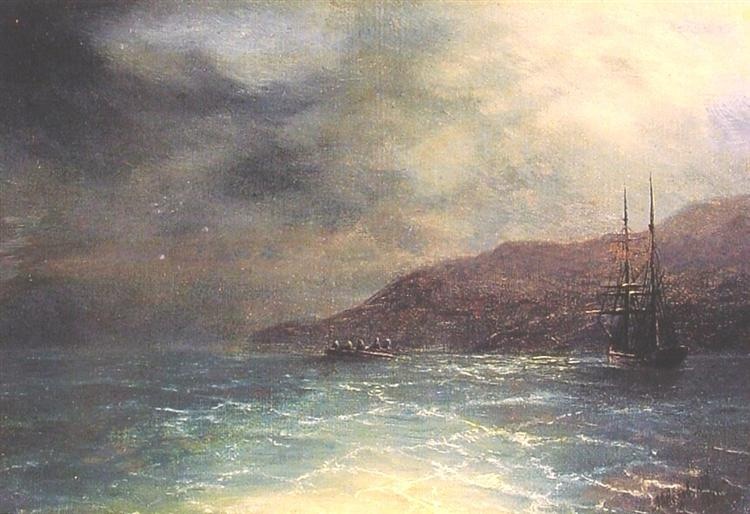
Image: Nocturnal Voyage by Ivan Aivazovsky (19th c.)
 Fish In the Afternoon