False words are not only evil in themselves, but they infect the soul with evil. – Plato, Phaedo
Apophasis. The cis soul denies, moves-away-from the dawn that beckons in the dark night. The problem they face is an allic problem: because they witness themselves as standard, they can’t recognize themselves as a one-in-many / many-in-one. The cis soul is one pattern of the pattern of gender, one echoic history in an endless sea. But it cannot see itself as one-among-others because its ontology rests on sovereignty. It is Leviathanic: it is that whose power is assumed, whose power grounds the many in one structure of authority. The cis soul can go so far as to say there are deviations from itself, but it cannot go so far as to say the gender they dwell in is not a privileged standard.
Souling as a woman and souling as a man are not reducible to souling as cis – to center cisness in one’s womaning and maning. The contradiction at the heart of the cis soul is that in sewing one’s cisness so close to the soul as to be inseparable, this cis identity clouds one’s gendering. In grounding their activity in their cisness, the cis soul must guard against any rupture to its sovereignty, any indication that the duadic form of cis gender-lives is one-among-many. One can only be a woman so far as one’s womaning fits with the duadic form of the cis soul; one can only man as a reflection of that form. The mistake here is the same that pervades civilization: to make-real the form at the expense of forgetting that that form is grounded in those-who-form. Commodity fetishism is one form of a greater idolatry, one that appears-again in the contradiction of the cis soul. The fundamental move of souling as cis is to forget one’s womaning and maning and to instead identify with the duadic form of cis men and cis women – to relocate their own activity to an idol that they created.
None of this is to say that the categories of cis and trans are empty. One can meaningfully identify as a cis woman or a trans woman because it identifies one within the social background within which one womans. However, there is a difference between identifying with one’s womanhood as a woman who has already been socially identified as a woman (that is, being a cis woman), and identifying with one’s place within the cis duad rather than one’s one womaning. The question is where the activity lies: does one woman as the woman they are, or do they woman according to the system that womans them? Breaking away from the cis soul, even while remaining cis, requires uprooting the sovereignty of cisness and relocating it in themselves, in others, and in the world. It requires anamnesis: re-membering oneself as the one-who-forms to escape the prison of the form.
The sad thing about Plato is he never did get out of that cave.
O my body! I dare not desert the likes of you in other men and women, nor the likes of the parts of you,

I believe the likes of you are to stand or fall with the likes of the soul, (and that they are the soul,)

I believe the likes of you shall stand or fall with my poems, and that they are my poems…

- Walt Whitman, Leaves of Grass
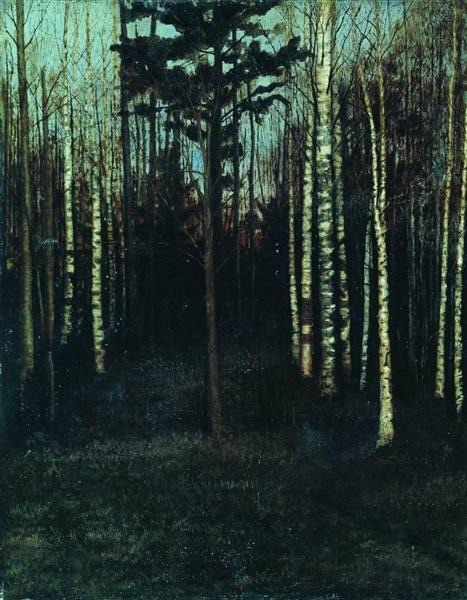
Image: About nightfall. Grove. By Isaac Levitan (1880)
 Fish In the Afternoon