How strange it is to be anything at all. – Jeff Mangum, In the Aeroplane Over the Sea
My writing tends toward fullness at the expense of clarity. There’s so much I want to say; so little that is immediately accessible to my cognition. So, instead of building a palace brick by brick I turn each brick into a sculpture, situating each word in a context that imbues it with overdetermined meaning. The multiplicity and mystery is the point; each word is a world.
But sometimes this gets nowhere. Sometimes I sit and want to speak, but meaning cannot be wrapped tightly enough to be gifted. This gap is the gap between significance and life-itself, between expressing and dwelling. All language is alienation. We alienate the pure quality of our experience, the rushing rhythm of our senses, to echo it out to others, hoping in its alienated form it will be seen by another. Originally, we sing — our vocal cords warble and strain, setting sail across the cosmos to be taken-up again by another. First, we listen, heartbeats and unknown speech and gentle swaying songs. Then, we sing as two, patty-cake patty-cake a baker’s man, Simon says, I see you. From the two the many erupts, joining in chorus and choir – gathering, hunting, eating, loving, fighting, worshipping, celebrating, lamenting. And it is in this many we find the one again, the echoic universe of the many allowing us to signify ourselves to the world.
Wait, wait, back again. The world. I sit here, contorted in an airline seat, hunched over and typing as a Tetris of city lights and farmland falls across the windowpane. I always try to poetry. I don’t want to right now. I want to say what poetry can’t. But it’s this problem of can’t that I’m not sure how to leap across. Wittgenstein helped me to navigate my sense and my nonsense, but what of that mystery he pointed to beyond? I wish I wasn’t sitting here in this uncomfortable seat. I wish I was sitting there with you, on our back porch swaddled in blankets watching the dogs wrestle in the soft grass. Soft. The line between expressing and being flows from the artifice to the sense that the artifice emerged from. There is more felt in a held hand than we can gather from a thousand sonnets. I want to hold your hand. But more than that. I want my hand to speak the sonnets that sing restlessly in my heart, the poetry of heartbeats of which written poetry is only an abstracted remnant. I want to give you my heart.
I love being your girl. Girl. Transitioning is a magic of place and a symphony of time. My body is one place; my body becomes another. I want to spend my time as a woman; I want to sing as a woman. I want to be a woman with you. What is it about me that shifts as I travel transition? Hormones flow and shift, cycles dis-membering and re-membering again. My skin softens, my fat travels, my body takes on a new form. In these shifts, I dwell more comfortably in my womanhood, seeing for the first time the woman-that-I-am. HRT does not make me a woman but it helps me to wipe away the clouds that obscure my womaning, that keep me separated from my body, my womanhood. Still, so much more remains — I want to be a woman with you, I want to woman with you. I’m your tomboy, hiding in my dysphoria hoodie seeing myself for the first time in the reflection of your honey-oak eyes. You’re my Odysseus, spiriting forward across the chaos and tumult to arrive again at the home we are building together. At the end of these trials, you will return as queen, I will return as Penelope. And then we will journey again. And return. And journey. And return. Always remaining a together – two women in love, swaddled in blankets on our back porch.
After philosophy, after poetry, two things remain: (1) the mystery of love, and (2) the mystery of womanhood. You cannot know either by knowing alone. You can only know by doing, by a leap of faith into the unknown, by kicking away the ladder of reason. I love because my life testifies to it – no poem will ever express the whole of love, because its significance is found not in language, but the world itself – in the act of loving. I am a woman because my life testifies to it – no theory will ever capture womanhood, because what it is to be a woman is to woman – the act of womaning. And here I sit, dwelling in these mysteries and moving through them, loving and womaning. And my soul aches. Because what I want is to love and woman with you. To sit on our back porch, swaddled in blankets watching the dogs wrestle in the soft grass.
Just two women in love.
The the the the the the. The the the the the the. – my heartbeat.
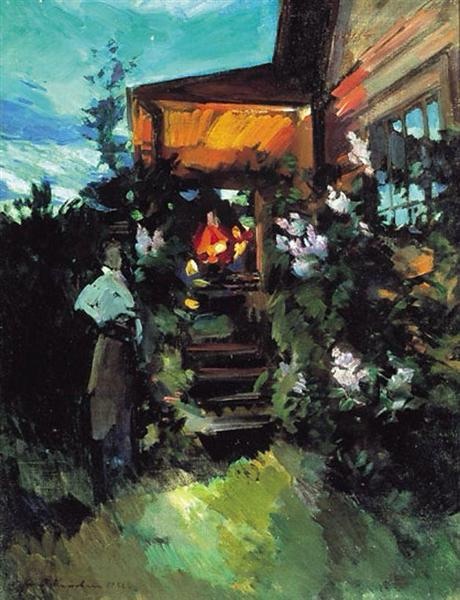
Image: Summer Evening on the Porch by Konstantin Korovin (1922)
 Fish In the Afternoon