God’s kingdom isn’t coming with signs that are easily noticed. Nor will people say, ‘Look, here it is!’ or ‘There it is!’ Don’t you see? God’s kingdom is already among you. – The Gospel of Luke 17.20-21 (CEB)
- In the beginning was the One.
- The One is Unique, itself-in-itself and irreplaceable by any other.
- The One is all-things by being no-thing: possibility-in-itself.
- The One articulates itself by becoming some-thing, by actualizing possibility.
- In this actualizing, the One Uniques, or articulates itself as what-it-is-in-itself, that being everything-together.
- This Uniquing of the One manifests the Many, the pluricosmos of Uniques that form the modal geography of the One’s self-becoming.
- This Many is also Unique, each articulation of the One being itself-in-itself and irreplaceable by any other, an individual within the geography of possibility-in-itself.
- Everything is Unique, both in its identity with the One and difference as part of the Many.
- This process of the One-Uniquing-as-Many can be poetically understood in Trinitarian terms as creating-begetting-proceeding.
- Creating-begetting-proceeding is the process of the self-becoming of the One-in-Many and Many-in-One, conjoined in creation.
- Creating-begetting-proceeding are co-substantial, always operating together as the same process, but take on different characters in its energeia, or its actualizing in the world.
- Creating articulates the creative self-becoming of all-things out of no-thing: some-thing-ing.
- Begetting articulates the echoic nature of self-becoming, how this some-thing-ing is echoed, or repeated-and-transformed, in generating the One-in-Many.
- Proceeding articulates the historical self-narration of the One-in-Many, through which the One Uniques as the Many and the Many re-members itself as the One.
- The union of creating-begetting-proceeding reflects both perichoresis, or the substantial interpenetration of the Many-in-One, and kenosis, or the self-giving of echoic becoming whereby the One empties-itself as the Many and the Many empties-itself as the One.
- All Uniques reflect the self-becoming of the One-in-Many by being co-substantial with this self-becoming, even while remaining Unique.
- All Uniques therefore reflect the process of creating-begetting-proceeding and of perichoretic kenosis.
- Uniques create, they bring-out-of-nothing the some-thing that they are.
- Uniques beget, they echo in their becoming, repeating what came before and transforming it, actualizing possibility.
- Uniques proceed, they self-narrate their difference as the Unique-that-they-are and in their identity with togethers, or the intertwined Uniquing of multiple Uniques.
- Uniques are perichoretic in that their Uniquing overlaps with the Uniquing of others, such that each Unique is itself a together, the identity of difference.
- Uniques are kenotic in that they Unique through being gifted their Uniquing by others and they gift that same Uniquing to others, each perichoretically self-emptying in togethering, literal self-giving.
- The process of Uniquing, whereby the Unique becomes the Unique-that-it-is, is also one of unfolding, creatively echoing the totality of one’s life, the origami of the soul.
- The soul is the life of the Unique understood in this totality, the fully-unfolded being of the Unique.
- The good of each Unique is the unfolding of the soul in eudaimonia, a joy that carries across a life: the good life.
- This Uniquing is always a Uniquing-with-others, intertwining in different togethers, which unfold as the together-that-they-are, as Unique as the Uniques that compose them.
- Togethering is the path to eudaimonia, a re-membering that unfolds the Many-in-One in its totality, an unveiling of the common-soul.
- In seeking the eudaimonia of the common-soul, we commit ourselves to the good of others, forming an ethical subjectivity by which our unfolding is oriented toward the good of the Unique togethers that compose our life.
- We unveil the good of each together in a way appropriate to it as the together-that-it-is, togethering as friends, as neighbors, as family, as lovers, and as part of a constellation of other togethers.
- At the heart of this togethering are those marked by love, a special way of togethering that attends to someone’s unfolding in a way that is free and homely, without possession or direction, and which aims only at the joy of their unfolding as the Unique-that-they-are; that is: love is attending to the unfolding of another.
- In unfolding, we matter, co-constituting the world as both that which matters-in-itself (the good-in-itself of the Unique) and that which matters-the-world (the good-of-the-world that is gifted by the Unique).
- In togethering, our matterings intertwine with those of others, gifting the good-of-the-world in a way that overlaps, requiring attention to the multiple matterings that co-constitute the good of the together.
- Love involves the intimate intertwining of Unique matterings, the souls of the beloveds overlapping as one entity – the doma – reflecting the perichoretic kenosis of the Many-in-One in creating-begetting-proceeding, or love-loving-love.
- Entering into the doma requires a mutual powerlessness marked by faith and charity; that is, it requires relinquishing one’s power-over-being to be-with-another, having faith in their free unfolding and charity in humbly emptying-oneself of possession.
- The doma is the hearth of the good, wherein children are born and parents lovingly-commit themselves both to their eudaimonia and to the self-consciousness needed to freely and creatively unfold as the Unique-that-they-are and to constitute their own ethical subjectivity.
- The love of the doma carries out into the whole world, love-loving-love acting as the model for other forms of ethical subjectivity, so that Uniques in their many togetherings may unveil the eudaimonia of the common-soul.
- Each of these togetherings echo the doma in requiring commitment and mutual powerlessness, orienting one’s activity towards the good of another and humbling oneself in faith and charity to empty oneself of possession.
- It is the practice of unfolding our commitments in mutual powerlessness that we call virtue, with the character (or patterning) of each virtue being dependent on the nature of the unfolding that it emerges from.
- One en-habits/inhabits this virtue through Sophia, or loving-wisdom, a commitment to embodying the Unique virtue(s) of the many Unique togethers of one’s life, orienting oneself to the good of each, and by extension, to the eudaimonia of the common-soul.
- Philosophy is the practice of loving-wisdom, learning to orient one’s intentions to the good of others and to the togethers that we compose, to attend to this good in our activity, and to unveil the conjoined mattering of all: being-as-meaning, or the joy of the common-soul.
And dost thou seek to find the one in two?
Only upon the old can build the new;
The symbol which you seek is found in you.
- Margaret Fuller, The One in All
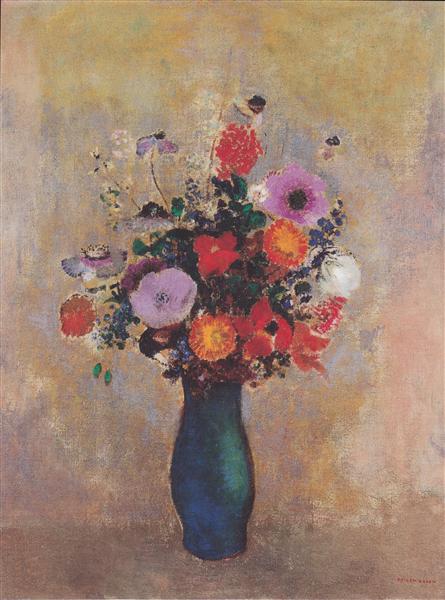
Image: Wildflowers by Odilon Redon (1906)
 Fish In the Afternoon