At a signal from the Principal the pupils, in ordered ranks, hands to the side, face the Flag. Another signal is given; every pupil gives the flag the military salute — right hand lifted, palm downward, to a line with the forehead and close to it. Standing thus, all repeat together, slowly, ‘I pledge allegiance to my Flag and the Republic for which it stands; one Nation indivisible, with Liberty and Justice for all.’ At the words, ‘to my Flag,’ the right hand is extended gracefully, palm upward, toward the Flag, and remains in this gesture till the end of the affirmation; whereupon all hands immediately drop to the side. – Francis Bellamy, The Youth’s Companion
1776 is not a year but a signifier. In the agon, matterings war with one another, emanating history. Long ago, Luther’s children escape the restoration, taking Cromwell’s skull to Turtle Island. Their God chooses, baptizing in water and pneuma. The first baptism is a sign of the second; the second is God’s will. Either way, the earth-soul breathes. The roundheads fence the world, reifying God in the market and separating themselves off as white. The Puritans mistake their flesh for divinity and case their hue as cosmogonic. The white world is birthed from idolatry, enfleshing the violent superego of settlers, slavers, and conquistadors. O woe to you, Vespucci.
The proletariat is an invention. In the dusk of the Black Death, the bourgeoisie emerge, exchange eclipsing feudalism as peasants are stripped of their land and women are burned on stakes. Capitalism is a witch hunt – the witch of rebellion that haunts history, the world turned upside down. Making the yuletide gay. Puritans are theologians of the market, crushing the un-chosen carolers with the God of enclosure. The kingdom collapses and its grave births Leviathan, Hobbes’ nightmare of man against man, the myth of the terror. Together, this terror and the Puritan God re-write history, capital crawling snarling out of the pit of England. America never left Plymouth Rock.
Capitalism starts from covenant, from the predestination of the saints. TULIP is an acronym for the Time-Machine. Lost on Mt. Ararat, the Rushdoonys whistle Yankee Doodle Dandy, burying theocracy in the heart of the slaver’s republic. In July, the plantation billionaire signs his separation, the teeth of the dead rotting in his mouth. Leviathan finds fathers for its parasitic creation: settler democracy. A demos of occupiers and property-owners, the double-image of the Athenian executors. Tyranny masks itself in the guise of the people, the general will confiscated by the homeowner’s association. Race becomes a mark for the covenant as women are privatized and the land is terraformed into territory. The mark of the pneuma is race-capital, the fetishization of value reified in flesh.
The fasces is a Roman invention, appropriated from the ash of Minos. Caesar glimpses the chi-rho written in the sky and the Carpenter is crowned king. No longer an executed criminal, the Begotten One is re-made in the image of the enslavers and occupiers, the temple of Augustus built on the ruins of Golgotha. The axe returns again-and-again, inaugurating Charlemagne, Washington, Bonaparte, and Hitler. At its core is the imperium, the synthesis of God and Caesar, carried from Augustus to their Puritan offspring. Yockey imagined what was already being born: a white imperium, carried from Europe to the occupied lands. Romulus kills Remus and spills his blood on the steps of the Capitol. The challenge of the Carpenter remains: to render unto Caesar what is Caesar’s. To not put your faith in false gods.
And in princes who cannot save.
As against this, the commodity-form, and the value-relation of the products of labor, within which it appears, have absolutely no connection with the physical nature of the commodity and the material relations arising out of this. It is nothing but the definite social relation, between men, themselves, which assumes here, for them, the fantastic form of a relation between things. In order, therefore, to find an analogy, we must take flight into the misty realm of religion. There the products of the human brain appear as autonomous figures endowed with a life of their own, which enter into relations, both with each other and with the human race. So it is in the world of commodities with the products of men's hands. I call this the fetishism which attaches itself to the products of labor as soon as they are produced as commodities, and is, therefore, inseparable from the production of commodities. - Karl Marx, Capital, Vol. 1
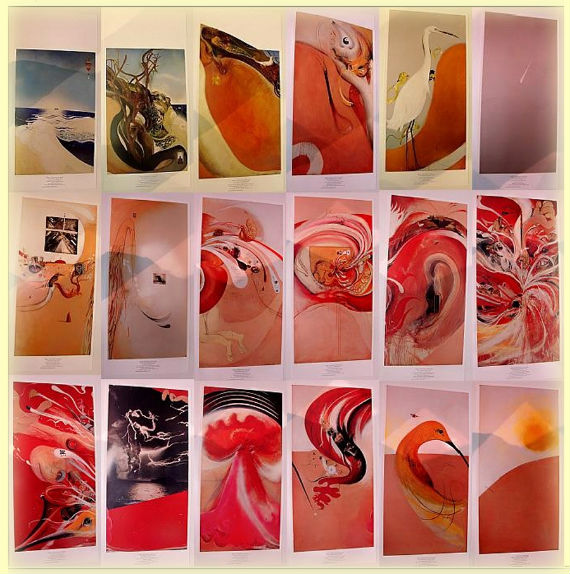
Image: American Dream by Brett Whiteley (1969)
 Fish In the Afternoon