Home is where the heart is. – Pliny the Elder
Here.
En-placed and en-homed, togethers draw-together in the doma. Sophia is loving-wisdom, and one wisely-loves only in place and in time. Placetime. I am here-, now-, with-you. I am never nowhere and nowhen; where and when are always -with-. Being inhabits being in dwelling in the here-and-now with-you, the neverplaceless moment of togethering. I Sophia onward the dawning sunlight, the in-the-world that inaugurates the here.
Placetime has the quality of hereness, but this hereness emerges from the act of dwelling rather than the naming of place. I dwell in the world, not in ‘America’. The -time of placetime is itself timeless, a being-now that qualifies rather than quantifies, the never-measured ellipsis of doing through which the Unique Uniques. Placetime is the arena of Uniquing, the unfolding of Unique-togethers in their Unique dwelling. This togethering architects the doma, the home or nest where the unfolding of each overlaps the unfolding of another and matters the matter of their dwelling. The doma is not nowhere or nowhen but a -where and -when so close to the skin that each atom vibrates the history of the together. Uniques unique together in the historying of their dwelling, making home in the warmth of their being-with. Togethers hearthing together.
The good of the doma is the enacting of the good-itself: the Unique. This Uniquing is always a Uniquing-with, and the good of each Unique is the good of the dwelling in which the Unique resides. Because of this, to enact the form of the good, each Unique must attend to the Uniqueness of their Unique together, loving-wisdom being a loving-dwelling with the beloved Unique. Love loving love is the essence of the good, reflecting the creating-begetting-proceeding of the all. The oikonomia of the doma is an energeia, Uniques in hypostatic union acting-together to unfold their together in the world, nesting virtue. To enact the good, one must en-home.
With you.
Every beloved object is the center point of a paradise. – Novalis, Fragment No. 51
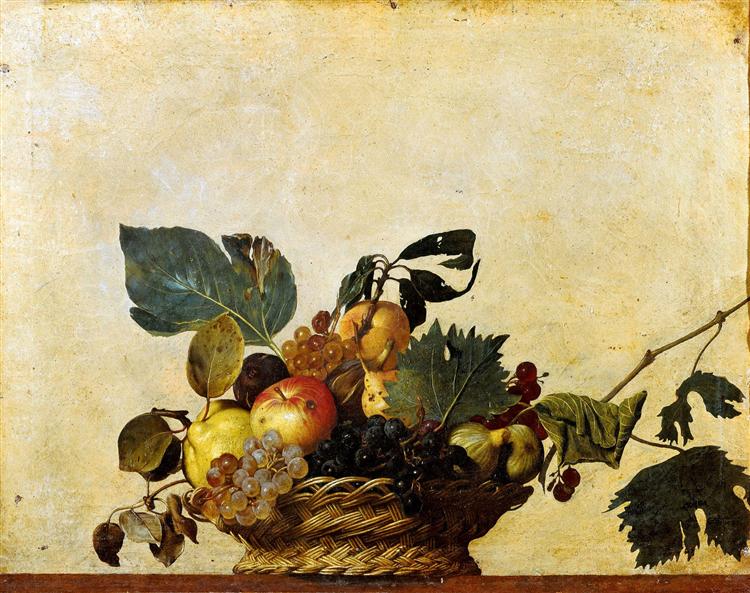
Image: Basket of Fruit by Caravaggio (~1596)
 Fish In the Afternoon