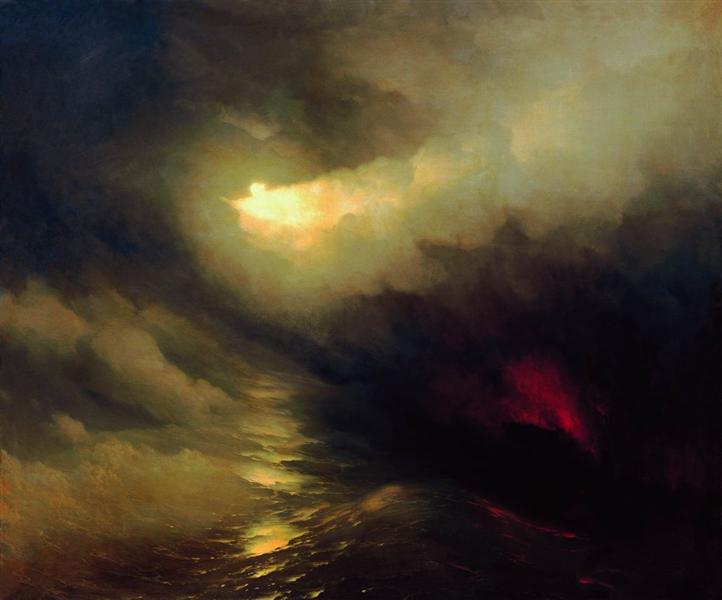
Ὣς οὐκ ἔστι Διὸς κλέψαι νόον οὐδὲ παρελθεῖν. – Hesiod, Theogony
Before Thales, Hesiod teaches his son how to farm. In the beginning, Earth and Sky meet in intimate union, Eros peering from the clouds. The Titans emerge from a dirt-womb and sever the authority of the Sky. Ruling over the before, the Harvest wields its sickle, swallowing its stone children before being gutted by the Law. The Law hiding in the mountains, early humans wade through the forests before receiving Fire from Thought. In fear, the Hearth creates the All-Giver, suffering escaping just as hope remains. Metals cascade down into human hierarchies, the union of Earth and Sky melting into social order. From these myths, a way-to-be is born, and through these myths Hesiod teaches his son to be a farmer and a man.
Myths are both descriptive and justificatory: they both how the world is and why it is that way. The stories form an image of the real and through appealing to this real the human-made realm below is reproduced, social order mimicking the stories that have been told to enforce it. Myth pervades meaning, the descriptive and justificatory overlapping in our tellings, transforming into art, science, literature, work, home, and palace. Are the constellations a myth? The stars exist, but the patterns between them are imposed by us, human myths granting meaning to the arrangements of celestial bodies. These patterns create cosmic coherence, Sky and Earth joined together again, grounding and transcending human life. They both give and take away.
The danger of these myths is mything the real: imagining that what is presents itself immediately without the interference of our myths, allowing the myth to pervade life. We sense a world, presented to us as a collection of atoms bouncing off the perceptual systems of our body and coalescing into sounds and smells and images and feelings and tastes and emotions and textures and fractals. These sense impressions are formed-together into maps of the external, our inherited concepts giving meaning to the flux of the is. The world we experience is a world of values, spatiotemporal dreamscapes imbued with do’s and don’ts, and this and thats to be treated in a this and that sorta way. On and on into the whole of “common sense,” a sense of the stories common to an imagined us. The is hides behind the image.
Trapped in the cave, it is unclear where our myths end and the real begins. Aporia dances the unthought-between: the dialectic.
An entire mythology is stored within our language. – Ludwig Wittgenstein, Philosophical Occasions
 Fish In the Afternoon