“The first step towards philosophy is incredulity.”
Denis Diderot, Last Conversation
All philosophy is performance. It is a thing that we do – an action, a motion, a riff, a rhythm. Philosophy is movement.
Long ago, Thales looked into the sky and fell into a well. The stars are there, but what are the patterns between them? Egyptian priests devised equations to graph their movements, celestial bodies rotating in the night, but what stories do these movements tell? Looking above, the below projects its stories onto nature, balls of ionized gas becoming loops in a god’s belt. The world becomes conceptualized, forms springing from form.
Philosophy is the art and science of concepts, the ideas that we attach to the painterly impressions of the senses. Our concepts never emerge fully from ourselves but are born from the cauldron of history, phylogenetic structures cascading out of the self-understanding of people in community. Some of these we may call “fundamental” – what is being, what is knowing, what is God? But it is never clear where the fundamental lies, or what it is fundamental to. Do trees grow upward or do their roots tunnel down?
Philosophy is a practice of self-development, creative nothings dwelling in the anxiety of being, flapping hands towards the possibility of becoming. Philosophy is an art of love, of knowing through loving, the sincere desire to understand. Through this loving, we become better people, the desire to know folding into caring compassion. As we inhabit this love, we realize our finality, our limitedness, learning to reside in the horizon of death and humble ourselves before infinity.
This infinity is the unity of difference, the many in one within the monad, where all is found in all, mind within matter, spirit within nature. Philosophers may act as either gatekeepers or resisters of power, using their authority to protect the Academy or taking a hammer to its walls. Plato grovels before the king while Emma Goldman lights a fuse. “Question everything.” “Know thyself.” “The philosophers have hitherto only interpreted the world… [t]he point… is to change it.”
Philosophy is polydoxy, un-doxy, a rhythm stepping-out into unknowing – aporia.
(1) Corrupting the youth.
(2) Denying the gods of the city.
The crimes of Socrates
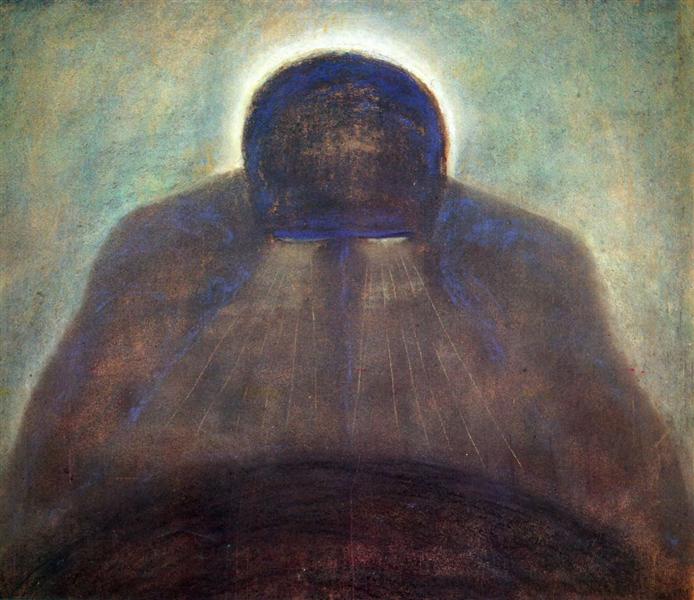
Image: The Thought by Mikalojus Konstantinas Ciurlionis (1904)
 Fish In the Afternoon