It is as painful perhaps to be awakened from a vision as to be born. – James Joyce, Ulysses
Philosophy tends towards the abstract, the reduction of multiplicity to unity, the concrete to its form, singletons to sets. This reduction occurs through investigation and classification, through collecting life into a pantheon of categories, taken to be the things-in-themselves rather the concrete thing: the thing-itself. The world-as-it-is is turned upside-down as a world-other-than-itself. Outside the Cave, the Unique, immanent forms, the itself-in-itself as-it-is. Loving-wisdom must return to the concrete.
Borges speaks of the Library of Babel as a network of interconnected rooms containing every combination of words, every locution, every bundle of enworded meaning. The whole of language. But, outside the Library the forests run far away, language never approaching the meaning of a kiss on the cheek. The whole of philosophy is less meaningful than the dance of a firefly. The Demiurge designs a ghost of what is here, and wisdom is exorcising this ghost, to return to the is that is.
The goal is the immediate; the eternal is already here. The Three-in-One is being-itself, holding us and grounding us and comforting us and rebuking us. It moves in us, such that there is no question of eternity. The question instead is eternity’s immanence, unfolding creation. The more we move away from immanence the more we move away from the divine and make life a heresy. God does not forsake creation but gives up heaven for earth, moving and breathing, weeping and laughing, struggling and desiring, suffering, dying, rising-again. For God so loved the world. God intends and attends and the infinite descends as the finite becomes eternal.
In the Cave, thoughts and sayings are no longer those of you or I, but those of Ideas. There is no conversation, only sublation-in-motion, the other-than-us as Spirit. I want the impressions again. And the impressions must appear in silence. Silence begins and silence speaks, impressions emerging as animation. The anima animates the silence into being-with, the Gemeinwesen patterning belonging. We stretch across the earth, no loyalty to the abstract, neighbor-love a dwelling-friendship that eclipses possession. The Leviathan spiders across time, an accumulation of many-histories mythologized into fatherhood. Its webs are made of capital, quality reduced to quantity, accelerating time by machinic desire. At the end lies Tartarus, the simulation of the real and its concretization in death. The occupation bellows death while the occupiers un-soul themselves.
Will is a turning and affirming. I affirm my loyalty and defend it through courage, giving-faith to immanent possibility. Crossing the wound of separation between home and here, love emanates divine will, attending to the attender that attends to the good-in-the-world. I enact the One in unfolding the Unique, affirming the form-of-the-good, the imago Dei of myself. In faith to this good, I never bow. The fundamental sin is idolatry, to take something else as a substitute for the Unique and for the One in the Unique. There is no intermediary between us and God; leave the Cave and let the sunshine freckle your soul, the wandering heat of Sophianic bliss. In loving-wisdom Sophia appears, ensouled matter mattering souls, spiritmatters dwelling in the home-of-the-world, the doma.
After the Cave, us.
When it comes to knowledge, the form of the good is seen last, and is seen only through effort. Once seen, it is reckoned to be the actual cause of all that is beautiful and right in everything, bringing to birth light, and the lord of light, in the visible realm, and providing truth and reason in the realm known by reason, where it is lord. Anyone who is to act intelligently, either in private or in public, must have had sight of this. – Plato, Republic
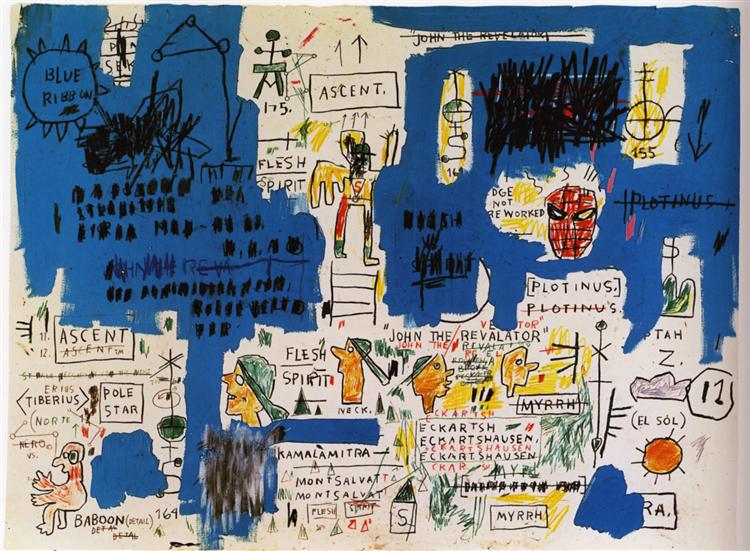
Image: Ascent by Jean-Michel Basquiat (1983)
 Fish In the Afternoon