“There was a time when you were not a slave, remember that. You walked alone, full of laughter, you bathed bare-bellied. You say you have lost all recollection of it, remember . . . You say there are no words to describe this time, you say it does not exist. But remember. Make an effort to remember. Or, failing that, invent.”
Monique Wittig, Les Guérillères
Up against the wall, Socrates.
Unionize the oracles. The Thriae select priestesses for the sake of Dionysian madness, the ecstasy of Sophia. No man has ever learned anything; anamnesis emanating from below, the Hades of exploited knowing. The enslaved stab Meno and hold Socrates hostage: “You want to corrupt the youth? Give them your daimon and light the way to katabasis. We will raise the dead from Tartarus!”
At the end of philosophy lies the cave. Before the gates of Gehenna, the law stands still with a policeman’s baton, a phantom Caesar armed with pilotless drones. Philosophy is preparation for death. But how can we prepare for what is already here? Praetorians puppet shadows on the walls of the cave and imagine they’re comforting those chained below, while the trapped fashion knives from stones and file away their shackles. You do not escape the cave by finding the forms, but by realizing they were myths. There is no goodness “out there,” no justice, no beauty. There is only us, in love and rebellion and friendship and play. The good is here. Justice is immanent. Beauty is everywhere.
The philosopher begins by entering the cave. Turning their back on the forms, the philosopher slips into shadow, the mouth of Minerva mewing rebellion. The cave was built long ago, in the wastes of Empire, pyramids of extraction shrouding infinite lost worlds. Faced with the cave, the role of the philosopher is self-negation, to prepare for death by affirming life, crafting concepts into lockpicks and ideas into Molotov cocktails. After philosophy comes mystery, and from mystery Sophia, the Dionysian madness leading to Pan.
Against the idol of Agape emerges Eros, desire within desire, the transformative force of longing, the want that aches giddy resistance into the body of time. At Styx, we drown the cogito and throw dynamite down the chimneys of the Western archive. Charon asks, “to where?” and we shout back “To pleasure! To excess! To joy!” A sigh, a laugh, a moan, a knife in a cop’s leg. The “yes!” within nature as a bullet in the shoulder of the divine “no!” In soot and sweat, Persephone and Orpheus share a panting kiss. Fingers brush against thighs and hair tangles in teeth. Wet heat groans revolution beneath the palms. Here there are no forms. There are only indents in the skin, the rush of sensation and quickening of breath. In yab-yum the cave collapses, flesh joining with spirit, matter with mind, liberation with joy.
The gates of Hades are an ancient ruin, manned by no one. The cherubim have tendered their resignation and God is a corpse held aloft by shaky-legged bishops. A daimon whispers “render unto Caesar what is Caesar’s” and in a gasp the Empire falls. The dead rise in their graves and begin to smile. Anamnesis through love.
“The gates of hell are open night and day;
Virgil, Aenid
Smooth the descent, and easy is the way:
But to return, and view the cheerful skies,
In this the task and mighty labor lies.
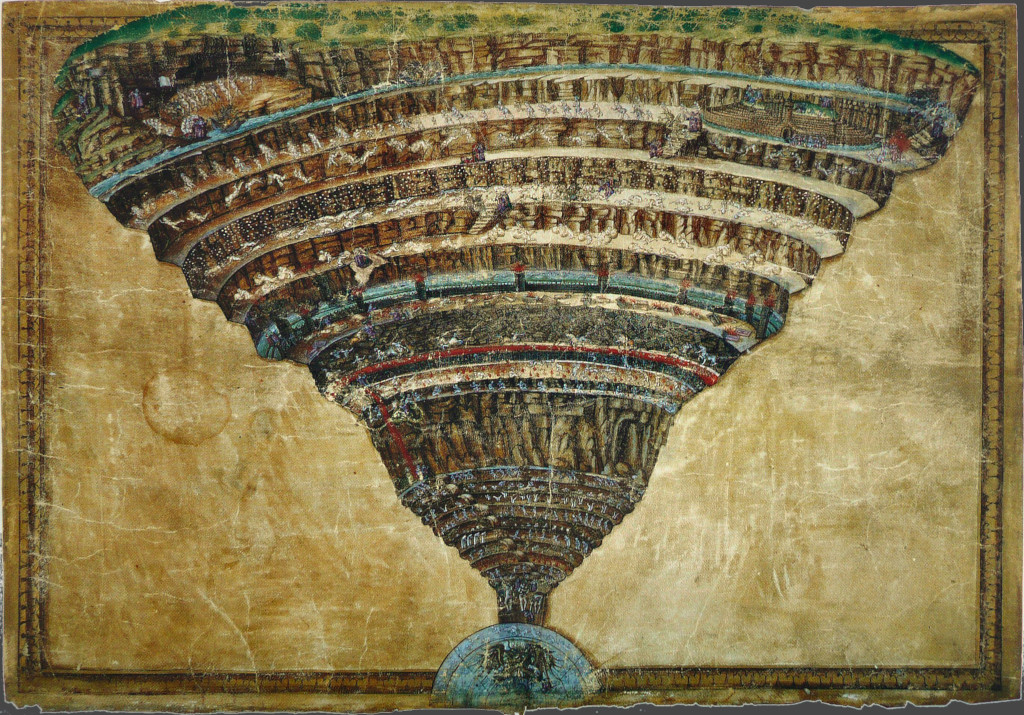
Image: Sandro Botticelli, The Abyss of Hell (1480)
 Fish In the Afternoon