In the abyss, God desires.
Whole fragment of spiritual flesh, Sophia haloing ecstatic into embodied creation. Matter becomes through yearning. Why is there anything rather than nothing? Why is there many rather than none? Because of love, ache. Because of first desire, the inhabiting of the nothing that calls out to everything and in so doing fractures into kaleidoscopic modality, possibility emanating from longing. God is because God loves; creation is because creation desires.
To be is to be-with – initially zero and then two. The one is the consequent of the two, the many. Cycles of time are erotic rhythms, cosmic sexuality flowing into multiplicity, love letters flaring into possible worlds. David Lewis was right – all possible things exist, actuality wrapping over spatiotemporal holes into infinity – but what he missed was the desire behind it, the longing of the universe to be through becoming. First love, then God and creation.
Love is incarnation, creative potential flowing into formed inhabiting, desire becoming being through dwelling. We cannot know without loving and cannot be without being-with, possibility becoming necessity through committing ourselves to the good of another, to the good of the world. Modality sings Sophia, wisdom vibrating with the holiness of eros, longing shimmering with potential and potential radiating into ecstatic union. To be is to intertwine, allowing ourselves to unfold through attending to the unfolding of another, the soul developing through a harmonics of intersubjectivity.
Love is the root of knowledge, that which makes knowing possible, the desire within desire that bursts into revelation. We cannot know without loving, for to know is to dwell in the thisness of another, to be-with the world. Love is the precondition for possibility and possibility is the precondition for knowledge.
In the abyss, God loves.
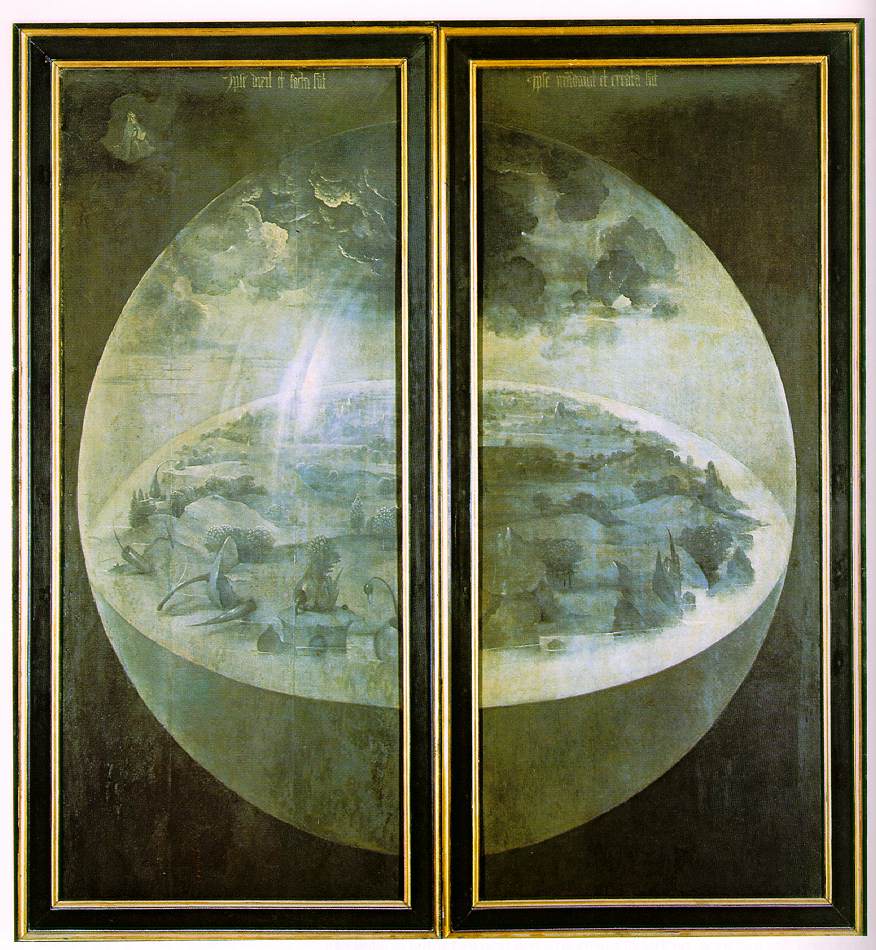
Image: Creation, from the outside shutters of Hieronymus Bosch’s The Garden of Earthly Delights (c. 1490-1510)
 Fish In the Afternoon